Oathtaker.com
Friend and follow Patricia Reding
  • Home
  • Patricia's Blog and Interviews
  • Patricia's Reviews of Other Works

Tales of Publication—and Re-publication, Part 1

5/5/2014

0 Comments

 
Just over a year ago, I went to publication with my first work. It was all so exciting. But like many an author before me, I also found it all rather confusing. Formatting issues, font issues, cover issues, naming issues (for myself and the book), whether to have a print copy or stick just with an e-book, and so on and so on. Overwhelmed (and more than a little busy with my day job), I decided to use a third party publishing company. While they did an excellent job preparing the work for print and e-copy, the process unfortunately left me with little control over all the issues that came to matter to me most once the book was actually available to readers. Chief among them: I was unable to control the price. As a consequence, I had difficultly moving the work even though the reviews I got were wonderfully encouraging (including 5-star reviews from various Readers’ Favorite reviewers).

Taking my hits, I decided that once my contract with the publisher expired, I would re-publish on my own. So back I went to addressing all those questions that had overwhelmed me the first time around. The changing seasons inbetween times had done nothing to lessen the difficulty I had in facing and resolving those issues. Indeed, in some ways, I ended up with even more questions and issues to resolve.

The first thing I had to decide was whether I would make any “substantive” changes to the work or simply re-publish it in the same form. To make the most of my efforts, I decided to do another edit. This would allow me to address any issues that readers had mentioned to date and in that way, improve upon the work. I should say here that my work best fits in the category of “epic” fantasy. An epic fantasy includes the creation of a new world and a system of magic. It takes time to create such a world. Thus, epic fantasy works tend to be on the “longer” side. For my part, I can say that I do not read epic fantasies just to finish the stories—I read them to get lost in new worlds for as long as possible. Accordingly, as a reader, I am fine with a book of any length. (I am always first drawn to those in the 600+ range. No doubt I’ve missed many a great work that just wasn’t long enough to capture my attention at the outset . . . .) Even so, for my own work, I set out to cut whatever I could, wherever I could, without changing the story that others had enjoyed and without removing those bits upon which future stories in the series will rely. (It is amazing, how long it takes to get the words down and how fast they can disappear . . . .)

Picture
While editing, I also tried the beta reader approach but, I must say, there seems to be a science to it that was somewhat lost on me. I can see it working beautifully for a work-in-progress. But, it is a bit different for a “finished” work. I really appreciated my beta readers’ time and wonderful suggestions. However, as I was the only one with the “big picture” in mind, many of their ideas were wholly unworkable. Moreover, it took time for them to read and comment and for me to sort through those comments for the gems I could use. For the most part, I was subject to my readers’ time schedules and so, they were dictating the pace of my progress. However, I simply could not wait weeks or even months for someone else to attend to my work. Also, I felt guilty taking the time of others who had their own lives to attend to. So, while they dissected every idea, sentence, description and conversation to indicate how they would have written the work—a work with which they were not familiar and for which they did not know the “big picture”—I struggled.

About that time, two things happened that saved me.  First, several prior readers contacted me to inquire when part two would be ready, as they are anxiously awaiting it. Second, another author reminded me: “we cannot write by committee.” My beta readers had only gone through the early scenes. I took from their comments what I could, applied those principles throughout, then wrapped up my own editing.

Finally, as I neared completing my edits, I looked forward to the next major issue: what to do for my cover. Next time I will tell about who I worked with for my cover. I’ll take you on the photo shoot and even introduce you to the model. Until then!



0 Comments

Self-Editing

4/4/2014

0 Comments

 
Picture
This month, we three Quills are exploring the concept of self-editing. 
Picture


Robin Lythgoe, author of As the Crow Flies, is up first. Her website is found here.


Is it possible to self-edit your book? Yes, but…

It’s really hard to do it on your own! Kristie gives some excellent advice in her part of the panel—worth repeating, so read it again but with my voice in your head.

I recently read a best-selling novel written by an indie author who claimed to have run the manuscript several times through a couple of editors. The experience left me slack-jawed. I do not know if the editors (two of them!) were really that bad, or if the author simply didn’t implement their suggestions. Unfortunately, the former is all too possible. One can find many “editors” online, but that doesn’t mean they can actually do the work. The aforementioned one came with a website and all sorts of credentials, which leaves me wondering. A large portion of the errors could have been fixed “in house” if the author had followed Kristie’s advice, but…

This requires an author actually knowing what adverbs/adjectives are and how to use them, how to properly punctuate and spell, understanding point of view, recognizing the difference between active and passive voice, and so on. There are an astonishing number of authors who don’t, or who believe it doesn’t really matter. It does. Take the time to learn. A writer should always be learning. In addition to trade books, we get to read fiction! Lots of fiction! One of the coolest things about reading is how we start assimilating what we read: we learn how to spell and to punctuate, we pick up the rhythm of words in a tale, we learn how to weave a story.

There are several fantastic online editing aids available to you. Use those, too. Here are a few to get you started:

Grammarly http://www.grammarly.com/

Writing Dynamo http://dynamo.dictionary.com/writing-dynamo/tour

ProWritingAid http://prowritingaid.com/

Hemingway http://www.hemingwayapp.com/

AutoCrit Editing Wizard https://www.autocrit.com/index.php

Next, you need to form a good beta reader group (not less than three) to test your manuscript. Your readers should be in your target audience, forthright but tactful, not related to you, and regular readers (in your genre) that understand how a book is structured.

And finally, there are some very decent books to help you with self-editing:

Revision & Editing, by James Scott Bell http://www.amazon.com/Revision-Self-Editing-Publication-Transforming-ebook/dp/B00B03HSEW

Self-Editing for Fiction Writers, 2n Edition: How to Edit Yourself Into Print, by Renni Browne and Dave King http://www.amazon.com/Self-Editing-Fiction-Writers-Second-Edition-ebook/dp/B003JBI2YI

The Little Book of Self-Editing for Writers: 12 Ways to Take Your Book from Good to Great, by Bridget McKenna http://www.amazon.com/gp/product/B008HZC80A


Great advice, Robin! 
Picture


Now for Kristie Kiessling. Kristie is the author of the short story, Sanguis Dei and of a poetry collection, Light and Dark. Kristie’s blog is found here.

Is it possible to self-edit your book?

YES! In fact, even if you hire an editor, you MUST be able to self-edit your book or you will be wasting money. As Kristen Lamb says, there are many editors who charge by the hour. Don't waste money on edits you can do yourself! If you hire an editor, you want him or her to be looking at the guts and glory, the meat and potatoes of your story not the dinnerware--in other words, don't have an editor clearing out overused adverbs and fixing repetitive, common errors that YOU can fix.

Site after site on the internet can help you self-edit well. USE them!

Just because you may hire an editor does not mean you won't be self-editing. Every writer must do some self-editing and if you, like me, can't afford an editor in the beginning for that first novel, don't be terrified. It isn't the end of the world. If you can write a good hook, you can edit that hook.

Here are just three of some of the many rules for the success of your first self-edit: 

1--Put space between yourself and your work. Finish a story and give yourself a month to step away from it before you begin editing. Don't think about it, work on it or play with it.

2--Edit hard copy. Make changes right on the paper, look for continuity, frequently repeated words or common usage errors. It's all easier to see on paper without the danger of deleting something you might want to keep.

3--Read it out loud. Dialogue that looks good on the screen or on paper can sound campy, stilted or downright ridiculous when read out loud. This tip also helps with long, detailed sections of descriptions. If you get tired of reading it aloud, your readers will get tired of it, too.

It isn't easy, but it can be done. Stick to it! Check out these websites for more helpful tips on self-editing your novel. You'll find some great stuff in these pages: 

http://www.stevenjcarroll.com/authors-corner/advice-for-self-editing-your-novel/

http://www.helpingwritersbecomeauthors.com/2013/06/how-i-self-edit-my-novels-15-steps-from.html

http://warriorwriters.wordpress.com/2013/08/21/six-easy-tips-for-self-editing-your-fiction/

Thank you, Kristie!  There is some great advice there! 
Picture


Finally, here are my thoughts.


Is it possible to edit your own work? I think so, though it is difficult. I direct your attention to some terrific resources my fellow Quills shared with you today. They address many potential pitfalls, all of which it is wise to address and consider. The one thing those resources do not address, however, is the possibility of losing your story for the sake of pleasing someone else.

I have conversed over the past few days with an author whose work I’ve read and very much enjoyed. I explained how I am going through another round of edits and have reached the point where I am changing things one way, then changing them back. (At this rate, I will never make it to the end.) I mentioned to him that I had others reading as beta readers. While they had only gone through the first few chapters, they had addressed critical issues. I cannot say enough how much I appreciate their time and effort on my behalf. Some of their ideas I adopted readily. Others, if I were to follow, would cause the entire story to fall apart. The author I mentioned explained to me how precisely that had happened to one of his earlier works. He changed things until the story was no longer his own—and no longer one he enjoyed or would share. It sits on a shelf where it collects dust. “We cannot write by committee,” he told me.

The author of a work is the only one with the big picture—the only one who sees how each meeting, each conversation fits into the whole. While there are all sorts of grammar rules, point of view issues and so forth that need to be addressed, there is also the author’s own voice and unique story to consider.

During my editing process, I picked up a best selling work by one of my favorite authors, one I’ve read several times and will probably read again. I discovered that of its 962 pages, I could easily cut 350 without changing the story one whit. How? I would remove repeated material and unnecessary adjectives and change passive voice to active—and that’s about it. According to the “rules,” the author had done a lot “wrong.” Still, I’ve read that book over and over and have enjoyed the story every single time—as have many others. In part, I enjoyed it because of the author’s own perspective and voice, its strengths and its “weaknesses.” This process reinforced something for me: some people will like my work, some will not.

So, can you edit your own work? Yes. Use the materials available and make it the best you can—but stay true to yourself. Tell your story, not someone else’s. Use your voice, not someone else’s. Follow your instincts—and then be prepared: some will like it, some will not.

0 Comments

Books We Love

3/6/2014

0 Comments

 
Picture
This months, we three Quills are sharing about "books we love."  
Picture
Kristie Kiessling is up first. Kristie is the author of the short story, Sanguis Dei and of a poetry collection, Light and Dark. Kristie's blog is found here.

When faced with the topic for this first Friday, Books We Love, I immediately considered the Hobbit and the Lord of the Rings, but a commentary or review of any of those would take far more than my allotted space.  Besides, by now, everyone knows the tale because of the movies.

Instead, let me share with you my love for author Stephen Lawhead and his revisionary telling of the story of Robin Hood in his King Raven Trilogy consisting of Hood, Tuck and Scarlet.

In Hood, we are introduced to a young man--heir to his father's lands--who takes only his own pleasure seriously. When Norman invaders arrive and wreck havoc, he tries to buy back the land, but finds himself pursued, his life in danger. He abandons his father's kingdom and people and runs to hide in the greenwood. There, Bran ap Brychan discovers the old growth forest in Wales is more than meets his wayward eye. He must come to grips with the mystery of this living, breathing entity. More than that, he must claim it in order to survive and become what he is truly meant to be: no common thief as the Nomans think, but a man with a mission ordained by forces far beyond his ken.

Lawhead writes with enviable knowledge. His research is deep and reveals fresh, relatable insights to times gone by. He draws the reader into the intricacies of politics, intrigue and life of ancient times that are not so very different from our own. His writing reflects in subtle and clever ways on our modern ideals and behaviors. I enjoy reading his books more than once--the mark of a great author. When I do, I am drawn again into a kinship with my own Welsh ancestors and Lawhead makes me yearn for that rich past.


Picture
Robin Lythgoe is next. Robin is the author of As the Crow Flies and two short stories.  Her website may be found here.

The collection of books I like is pretty large, but the Books I Love are actually few. I considered Lawhead’s Hood, but Kristie nabbed that right up. No surprise, there! (And with good reason, too.) I talk about Tad Williams’s series, Memory, Sorrow, and Thorn rather a lot, so it’s clearly time for something else. If you haven’t read the Damiano Books (I’ve also seen them in a one-volume set called Trio for a Lute) you are missing a real treat.

Damiano is set against the backdrop of the Italian Renaissance where faith-based magic is real. A wizard’s son, an innocent, a musician, Damiano is befriended and instructed by the archangel Raphael. To save his city from war, he sets out on a quest to find a powerful sorceress. Along the way he is beset by betrayal, disillusionment, and death—and still he must confront the power and darkness within himself in order to protect those he loves. Damiano wants to use his powers for good, yet he’s certain that since he’s a witch he’s automatically damned.

MacAvoy’s prose is beautifully lyrical, and her settings come alive with allusions to historical events, people, and society. The characters are real, they’re believable, and they face truly difficult issues. She has a talent for revealing how lovely, wonderful and terrible the world can be, and how difficult the struggle to know what’s right and wrong.


Picture
And finally, moi.


Recently I read a couple works I found worthy of including in my list of favorites:  the Mistborn series by Brandon Sanderson and The Lightbringer series by Brent Weeks.  In the Sanderson stories, characters “spin” magic via their use of different metals. In the Weeks stories, colors fuel the magic. I found only one real fault with Mistborn. While Sanderson drew a believable young female protagonist, she was not “whole” for me, perhaps because I found the relationships somewhat lacking.  Having said that, the magic system is highly creative and great fun. As to the Lightbringer series, I found the characters fun and believable and the personal relationships, which are central to the story, satisfying and genuine. As a bonus I laughed out loud—fairly frequently.

As I consider these tales, I see a common denominator: each delivers a “new” world and unique magic. For Sanderson, it is the characters’ use of metals to “read” others’ emotions, bring about certain events, travel and communicate. For Weeks, it was the magic of colors to create things and the way those who wield the magic of different colors are prone to certain personality characteristics. These authors delivered something outside the standard fantasy tale (complete with a wizard and a troll and a fairy and an elf . . . and so on and so on). Each delivered a new kind of magic and a new category of fantasy character. Best of all, each opened a new world to me—a world in which I lost myself—if only for a time . . . .    


0 Comments

Day Jobs

3/1/2014

0 Comments

 
Picture
This month we three quills decided to write about how our day jobs effect our writing.

ROBIN LYTHGOE, author of As the Crow Flies is up first.
Picture
Hmmm, how does my day job affect my writing? At this point in my life I am fortunate to be able to claim writing as my day job. My husband and I are empty-nesters, though we still have one daughter taking up space. We see her about as much as we see her siblings who don’t live at home. It’s pretty quiet around here now!

Most of my growing up was done away from the city, so I spent a lot of time on my own, mostly with books. My mom used to take me and my younger sister to the library, and we read stacks and stacks of books. I briefly romanticized about being a poet, but my poetry pretty much stinks, and I would rather have written it than read it. Some wonderful teachers in high school encouraged my writing—and I wrote a lot, though as a shy, awkward introvert, I kept most of it to myself.

After high school I got a job in a florist shop, then trained to become a solder technician at a high-tech communications company. Such different jobs! Such different people! Then I moved to the city, got a job at a book store, married, and started a family. With four little ones to guide, teach, cuddle and clean up after, my writing mostly fell to the wayside. Not completely, though! There is a photo of me sitting at an old Apple IIe computer with a screaming baby in my lap. Needless to say, screaming and writing didn’t work well together, and the squeaky wheels get oiled. I eventually got up the nerve to send some of my shorter works out, and I have a modest stack of rejection letters. I was thrilled when Marion Zimmer Bradley took the time to personally comment about a story—except her comments suggested that she hadn’t even read the piece!

I was blessed to be a Domestic Engineer for most of the kids-at-home time. What a fantastic, hands-on way to observe human development and interaction, eh? My husband and I managed apartments for a couple of years, and that was quite an eye-opening experience for me, not just for the “labor” involved, but about people we interacted with. I didn’t much enjoy the job at the time, but now I look back and laugh at the wonderful, bizarre, wildly divergent personalities and incidents we lived through, including a kidnapping, a hilarious Mutt-and-Jeff-looking couple, a single mom who posed for life drawing at the university and tried to hit on my husband, the couple who lived upstairs who inadvertently introduced me to Vangelis via their very nice stereo, and the fellow who lived downstairs and slept through setting his apartment on fire. (Not to fear, he was rescued unharmed by the intrepid firemen!) Fuel for my writing? You betcha. A job at the toy store introduced me to “the doll lady” (which was a little creepy, but sad). A commission to sew gowns—with a broken thumb!—for the ladies in a choir acquainted me with a lovely, warm gathering of mother hens. Working on family history turned up a few corkers and some humbling, inspirational, educational life stories. Church attendance and callings have kept me aware—and appreciative—of the Master’s hand in all we are and all we do. It exposes another glimmering facet of our existence and gives depth to the struggles and achievements we each go through.

All of these events have pulled me away from my writing to some degree, but at the same time they’ve enriched it, given me a broader perspective of people, and provided ideas for events and “human interest.” Frankly, I couldn’t write what I do without them.


Here is what Kristie Kiessling had to say:
Picture
I had to consider what my definition of job was to answer this question. People ask me what I do. In the years before I had the self-confidence to call myself an author, I told them, "I'm a mother." It was a title I could reach for before I understood that it was part of who I was, not a job that I did.

The inevitable response: "So you're a stay at home mom," implying that was my "job."

My reaction to that was, "Are moms only moms when they stay at home? I'm confused..."

But the answer to that is really "No." While being a mom is hard work, it was never my "job.” Loving my family and being a mom was never a job. Perhaps that explains why so many women who work very hard making a home for their children get upset when people say they don't work. Maybe they don't have a paying "job" but baby, they work!

To my way of thinking, a day job is something people go to, suffer the drudgery of, but get paid to endure. At the end of the day they do their level best to walk away from the "job." I see it far more clearly now. It is what we do at the end of the school day to earn some cash. It's what we do during and after college *before* we get to do the "real work" that we want to do. I believe everyone has something they were born to do. Sometimes, "jobs" become work. Sometimes "jobs" introduce us to our calling and that's what I mean when I say "real work." I base this on my faith bias, my belief that the Bible, one of my favorite books, is actually God's word. In scripture, *Work* is a Creation Mandate, a gift of God before the fall of man. It is not part of the curse that comes after man's fall; it is the joy of mankind using his abilities to his fullest that God calls work. The "work" of writing has always been with me. It is every day, all the time work. Like loving my family, it does not stop when the sun goes down.

A few months ago, our financial situation had me brushing up my resume. We have three kids in college. My husband and I discussed the possibility that I may need to get a "job." I would very much rather work at something I love than have a "job" because I've been there before; going to a job to earn money to pay for food and rent. I know the ins and outs of working for someone else. Some jobs I had, I could not endure. Some, however, became work I enjoyed. Work I could do to make others successful and happy, too. Believe it or not, my "job" at a well known department/grocery store became work that delighted me and engaged me—but that was because of the people I worked with and the environment my bosses created. Even then, though, during my breaks and lunches, I was writing. Writing is my creation mandated work and I love it. This time around, I added author to my resume and I had such joy doing that! I could even list years when I worked at my writing. Talk about "job satisfaction"!

I began writing novels at sixteen. Up until that time, the government required attendance at public school. The positive side of public school: angst for writing. Oh yeah. From sixteen to eighteen, I wrote the Great American Science Fiction Novel. Unfortunately, it was fueled by my obsession with Star Trek, my desire to BE Captain Kirk and was 700 pages long. An epic tale, impossible to sell to anyone because of a little thing called "copyrights,” never mind that it was fan-fiction (a word I didn't know at the time).

After that, I wrote eight original stories in the years from then until now. Each one a novel, each one as yet unpublished because I received one quite wonderful rejection slip in the mail and was so surprised at the kindness and wording that I now believe I became baffled as to what to do next. While baffled, I had babies—three of them. Though I kept writing, for that was the natural thing for me to do, I never quite managed to send out anymore work or find an agent.

As my children grew to adults, I spent less time on novels and more in online forums. It was a fast, easy and satisfying way to work at writing. The audience reaction I garnered gave instant satisfaction, but it was a distraction more than anything. In 2004 I met she-who-would-be my writing partner and we discovered the promised land of e-book publishing. She's worked very hard at her short stories and novel. I've produced a single short story and a collection of poetry. A novel is my shiny new goal. I cannot tell you how excited I am; there are no words for it!

As a mother, I performed a host of "jobs" many mothers do: Seamstress, Chef, Chauffeur, Financial Manager, Purchasing Agent, Laundress, Sanitation Engineer, Guidance Counselor, Psychologist, Mechanic and Maintenance Authority, Painter, Carpenter, Builder and Chief Medical Officer to name a few. (Maybe I should add those to my resume?) While I've done many jobs, I like to say that I don't have "a job." What I have is work I love, a family I adore, and every aspect of what I do in one affects the other both positively and negatively at times. All, I believe, working together for the good of one who loves God and is called to a purpose by her Creator according to his plan.


Finally, here are my thoughts:
Picture
Like most writers, I also have another “life.” I practice law. For the most part, my legal background is a benefit to writing. Admittedly, however, there is at least one downside to it . . . .

As an attorney, I am accustomed to looking for the holes in things. Why didn’t the character just do this obvious thing? Oh, I see. The story would be over. In that case, I need to identify why that did not happen, and I need my reader to know that I considered the option and disposed of it.

I also am continually aware of whether the pieces of something fit together cohesively and logically. Would that person really do/say that? Why not this other thing? Particularly for writing fantasy, these skills are essential. A fantasy tale may be outrageous—but it has to be “believable.” Finally, the writer may not use magic just to get out of a tough spot. He has to weave the “rules” into the story along the way.

Here is an example of a “hole” I found in my work. Dixon, one of the main characters, is a prisoner. Someone placed a band on his arm to cut off his magic. The protagonist, Mara, arrives unexpectedly. They share critical information. Mara then disappears when a visitor unexpectedly interrupts them. The problem? Well, the “rules” provided that Mara was the only person who could have removed the band (who would have done so). Why didn’t Dixon just ask her to remove it? I labored over how to solve the dilemma. If she removed the band, much of the story—including critical portions—would be moot. In the end, the “fix” was simple. Right after Mara disappears, Dixon notices the band on his arm. He cries: “Blast! I should have thought to have her remove this!” In light of what had just transpired, it was not altogether surprising that he did not think of this earlier. Thus, I “closed the hole” with a single line. Readers would have wondered about this if I had not done so. Further, the fact that Dixon forgot to tell Mara about the band became key to a later scene . . . .

As to internal consistency, I originally wrote that Basha had magic power to heal. Yet, she was the only one with access to Dixon while he was held prisoner. Had she healed him, she would have helped him to escape. I had to “write out” her ability to heal so that the remainder of the story would work.

As to not using magic because it is merely convenient, I had a scene where Mara needed to have a particular magic power—the ability to move things by thought. I could not just spring the power on my readers out of the blue. So I gave Mara this power earlier in the story. In the end, I laid some groundwork that might be important in the future. . . .

In Oathtaker, the laws regarding the transition of power are opposite the normal laws of descent. My legal training was helpful here because those laws are far more sophisticated than one might think. What if one member left survivors? What if he left survivors but did not release his power to them? What if no member left survivors or did not release his power to them? It got complicated, but it was interesting to turn some old rules upside down.

As I mentioned, a legal mind can also be a downside to writing. Specifically, we attorneys like to be “oh-so-very-clear” about things so that others may not claim misunderstanding later. Thus, for example, when two different words have two somewhat different meanings, we may use them both so that it is not supposed that we meant the precise meaning of the one, but not the other. Thus, due to my legal training, my biggest editing challenges are in–cutting!


Thank you for joining us! Please stop by again for our March post, coming soon!

0 Comments

Interview with Marsha A. Moore, Fantasy Author and GIVEAWAY Information

1/10/2014

2 Comments

 
Picture
I am delighted to bring to you today, an interview with Marsha A. Moore, an author of fantasy romance. 

Let's open with Marsha's bio:  

Much of her life feeds the creative flow she uses to weave highly imaginative tales. 

The magic of art and nature often spark life into her writing, as well as watercolor painting and drawing. After a move from Toledo to Tampa in 2008, she’s happily transformed into a Floridian, in love with the outdoors. Marsha is crazy about cycling. She lives with her husband on a large saltwater lagoon, where taking her kayak out for an hour or more is a real treat. She never has enough days spent at the beach, usually scribbling away at stories with toes wiggling in the sand. Every day at the beach is magical! She’s been a yoga enthusiast for over a decade and recently completed a year-long Kripalu-affiliated yoga teacher training program. The spiritual quest of her yoga studies helps her explore the mystical side of fantasy.


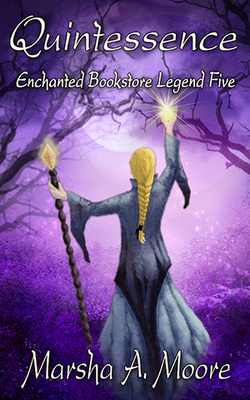
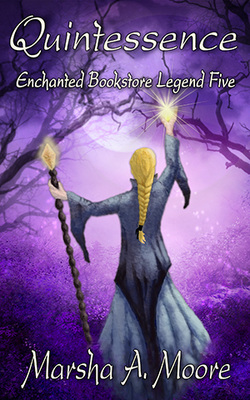
Welcome, Marsha, and “Congratulations” on your newest publication, Quintessence, the fifth and final installment of the Enchanted Bookstore Legends series.  

Picture
In light of this momentous occasion, this seems an opportune time for readers to get to know you better, so I thought I would open this interview by asking you what character most surprised you in your work and why?

Thank you for this opportunity. This is indeed a big event for me!

The most surprising character in my work was, to me, ten-year-old crippled child named Kessa whose mother sneaked her into hiding in the Imperial lair of the Alliance during Dark Realm attacks on their village. She made an appearance in Staurolite: Enchanted Bookstore Legend Four and commanded a far greater role than I’d planned. Her original intended task was to merely deliver a jewelry box filled with ancient magical trinkets to my heroine, Lyra McCauley. Kessa lit up while touching those items, and her own magic sparked my heart. I empowered the girl as a seer, the only one in the land for centuries. She even became a pivotal character to end the series in my latest release, Quintessence: Enchanted Bookstore Legend Five.

I write for those moments of surprise! Was there anything else in your work that flowed from the tips of your fingers without your having been aware that it was coming? If so, how did you react? Did it change the story you thought you were going to tell?


Reality always forms the framework of my stories. The more I look at this series, the more of myself I see. My heroine, Lyra, is very much connected to me. Even in the first chapter of the first book, the childhood memories brought to her mind by Cullen’s magical tea are actually all my own. How Lyra interacts with her Aunt Jean has been a way for me to work through my own issues with my mother’s failing health and passing. In some ways, how Lyra coped with loss was a way for me to deal with my own grief. The character’s emotions flowed more freely than usual.

I’m terribly sorry for your loss. Writing can serve so many purposes though, can’t it? It is not just a means of entertaining our readers, but sometimes also a means for us to ferret out truth, to gain wisdom and, perhaps, to impart some of that to our readers.  


Given your connection to your work, this may or may not be a difficult question, but what "other world" (which could be a time, place, or fantasy place) created in any book you've written or read is the world you would most like to visit and why?

During the three and a half years I wrote about the world of Dragonspeir and its characters, I do feel like I’ve paid extended visits to that land while writing each of the five books. However, to truly experience it three-dimensionally would be tremendous. I’d love to interact personally with the many talking trees and animals. Hearing the tinkles of flower blossoms in the enchanted Meadow of Peace, or Kenzo the giant tiger owl’s hearty laughter, or the snort of the Unicorn Guardian while he sprays sparkling aura along his spiraled horn…these things I long to experience firsthand.

It sounds like a wonderful world. While we are on the subjects of “alternates,” I wonder, what work created by someone else do you most wish you had written yourself and why?


There are so many. Magical realism books like The Girl Who Chased the Moon by Sarah Addison Allen and Practical Magic and The Green Witch by Alice Hoffman are delicately woven with the most sparkling magic. Other books that captivate me are Natasha Mostert’s Season of the Witch and Erin Morgenstern’s Night Circus. In both of those, magic caused mental effects for both the giver and receiver. I enjoy the complexity of that theme and employ it myself in a very different way. In the Enchanted Bookstore Legends, my heroine, Lyra, must learn to mentally control her vast inherited powers as the new Scribe. That is something she struggles to master through the series.

I find it interesting how some people read and only read within a single genre. Others (like me) read a wide variety of different kinds of works. What do you consider to be the five best works you have ever read and why do you rank them among the best?


See answer above.

That’s to the point! So then, let me ask this: what do you do when you pick up a work that does not entertain you? Do you read to the bitter end? Or do you bow out early?


I usually read to the end, unless I become bored by sexual interactions overtaking the original plot. 

I, too, usually read to the end. (I am always afraid that I might be missing out on something if I do not. . . .)


In light of your favorite reads, who is your favorite heroic character and in what way are you like him or her?

In the entire Enchanted Bookstore Legends, I admire my own heroine, Lyra, who faces a challenge she first believes she cannot meet—to save the Alliance portion of Dragonspeir from overthrow by the Dark Realm. This has been an ongoing conflict for hundreds of years, and Lyra’s ancestors—four strong female Scribes—have faced similar challenges. With her own immediate family members recently passed away, Lyra seeks to learn more about her predecessors and gains strength and determination from their examples. Yearning to feel connected to her family, she courageously accepts the challenges and dangers in order to continue their efforts. In doing so, she finds herself and much happiness that fills the voids from loss in her life.

So then, who is your favorite villain--and here’s the catch—in what way are you like him or her?


Eburscon, the evil alchemist, is my favorite villain. He’s the main antagonist of my Enchanted Bookstore Legends. I like him because he is incredibly intelligent. His arrogance and superiority are almost warranted. As a truly gifted alchemist, he holds the keys to all the power he desires…only Lyra’s compassion and strong will stand in his way.

You’ve definitely piqued my curiosity. I will have to add Enchanted Bookstore Legends to my “to-read” list. 


I have just a couple of remaining questions. First, in an effort to be certain that you get to present information of interest to you, what one question have you always wished an interviewer would ask you that you have not been asked and what is your answer to that question? Then, out of sheer contrariness, I must ask: what one question do you most dread an interviewer asking you and what is your answer to that question?

I’ve not been asked how it felt to complete a five-part epic series. It was much more emotional than I expected. For months or years, I’d been eager to realize the culmination of the twisted, interwoven storylines. However, when I approached the final five chapters in my writing process, I had to force myself to go on. I well knew what the plot required; I just didn’t want to part with my characters in that incredible fantasy land.

The question I most dread is where do my highly imaginative fantasy plots come from. There is no work or effort involved. Since my parents encouraged my creativity at an early age, I simply think that way. I wish I had a more complex answer. Admitting that I normally think about portals to other worlds seems a bit abnormal…good thing I’m a writer!

Well put! Finally, what one lesson, theme, or principle did you most want others to take from your work?


In my Enchanted Bookstore Legends series, there is an obvious theme—compassion is the clear path toward happiness. 

Thank you so much, Marsha, for taking time with me and for your willingness to spend some time in the “hot seat.” Best of luck to you and again, my sincerest “Congratulations!”  

Thank you, Patricia, for such an interesting interv
iew! 

Enchanted Bookstore Legends Series Description
Genre:  Epic Fantasy Romance

The Enchanted Bookstore Legends are about Lyra McCauley, a woman destined to become one of five strong women in her family who possess unique magical abilities and serve as Scribes in Dragonspeir. The Scribes span a long history, dating from 1200 to present day. Each Scribe is expected to journey through Dragonspeir, both the good and evil factions, then draft a written account. Each book contains magic with vast implications.

Lyra was first introduced to Dragonspeir as a young girl, when she met the high sorcerer, Cullen Drake, through a gift of one of those enchanted books. Using its magic, he escorted her into the parallel world of Dragonspeir. Years later, she lost that volume and forgot the world and Cullen. These legends begin where he finds her again—she is thirty-five, standing in his enchanted bookstore, and Dragonspeir needs her. 

When Lyra reopens that enchanted book, she confronts a series of quests where she is expected to save the good Alliance from destruction by the evil Black Dragon. While learning about her role, Lyra and Cullen fall in love. He is 220 years old and kept alive by Dragonspeir magic. Cullen will die if Dragonspeir is taken over by the evil faction…Lyra becomes the Scribe.
 

Purchase links:

Seeking a Scribe: Enchanted Bookstore Legend One

Amazon: http://www.amazon.com/dp/B007JVYSSI

Heritage Avenged: Enchanted Bookstore Legend Two

Amazon: http://www.amazon.com/dp/B0086OO07G

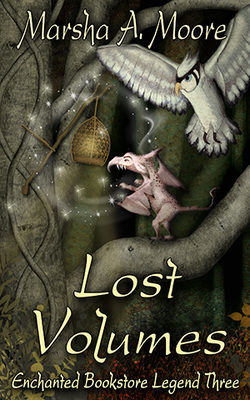
Lost Volumes: Enchanted Bookstore Legend Three

Amazon: http://www.amazon.com/dp/B009YNY18Q

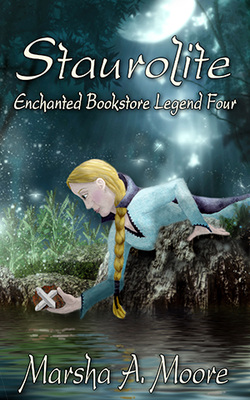
Staurolite: Enchanted Bookstore Legend Four

Amazon: http://www.amazon.com/dp/B00CCW98P2

Quintessence: Enchanted Bookstore Legend Five

Amazon: http://www.amazon.com/dp/B00H6LSFX0    

Contact Marsha, Like her and Follow her!

Website: http://MarshaAMoore.com

Facebook: http://www.facebook.com/marshaamooreauthorpage

Twitter: http://twitter.com/MarshaAMoore

Google +: https://plus.google.com/u/0/100564214132835514192/posts

ENTER - RAFFLECOPTER GIVEAWAY 

a Rafflecopter giveaway

Would you like to learn more?

Picture
Quintessence: Enchanted Bookstore Legend Five.


Barbaric Dark Realm warfare threatens to overtake all Dragonspeir lands, including the Alliance. Lyra McCauley, the fifth Scribe of the Alliance, finds herself in a desperate competition to gather four missing keystones. Those amulets of the four natural elements guarantee victory for the side possessing them. The Dark Realm’s alchemist, Eburscon, beats her to finding the water gem, the Pearl of Pendola. Three more keystones remain: the fluorite containing earth energy, the moonstone of the sky, and the fiery, dangerous Emtori Ruby.

The powerful gems, stolen centuries ago, channel astral energies and can restore much-needed Alliance power—the last hope. The wizard, Cullen, who is Lyra’s beloved, relies on Alliance magic for his immortality and will perish if the land falls to the Dark Realm.

Lyra uses her rare magical energies of quintessence and the Staurolite, governor of the four natural elements, to guide her to the hidden keystones. However, greed and power drive opponents, who challenge her in close pursuit, planning to destroy the Alliance, or to claim the power of quintessence for themselves.

The Dark Realm captures the ten-year-old Alliance seer, Kessa. Her abilities can give them information about the locations of the keystones, complicating Lyra’s plans. Will her love, allegiance, and quintessence allow her to save Cullen, Kessa, and the Alliance before the Dark Realm claims all of Dragonspeir?


MORE on The First Through Fourth Volumes:

Picture
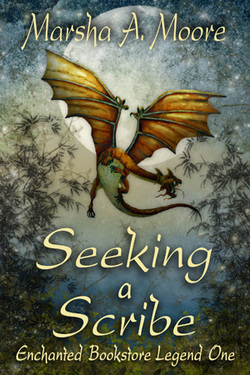
Seeking a Scribe:  Enchanted Bookstore Legend One.


Lyra McCauley is a writer and loves fantasy novels, but until she opens a selection from bookstore owner Cullen Drake, she has no idea he’s a wizard character who lives a double life inside that volume…or the story’s magic will compel her from the edge of depression to adventure, danger, and love. 

His gift to Lyra, the Book of Dragonspeir, was actually her copy, misplaced years ago. Lost in her pain following divorce and death, she fails to recognize him as her childhood playmate from the fantasyland. Friendship builds anew. Attraction sparks. But Lyra doubts whether a wizard is capable of love. She’s torn—should she protect her fragile heart or risk new love? 

Opening the book’s cover, she confronts a quest: save Dragonspeir from destruction by the Black Dragon before he utilizes power of August’s red moon to expand his strength and overthrow the opposing Imperial Dragon. Lyra accepts the challenge, fearing Cullen will perish if evil wins. Along with magical animal guides, Cullen helps her through many perils, but ultimately Lyra must use her own power…and time is running out.

When Lyra opens her lost childhood book, she remembers her destiny as the next Scribe and must save Dragonspeir's Alliance from overthrow by the Dark Realm.    


Picture
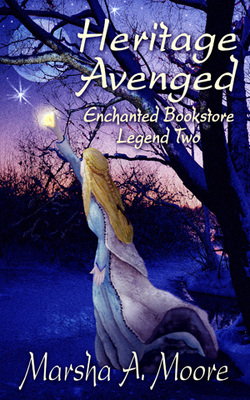
Heritage Avenged: Enchanted Bookstore Legend Two.


Lyra McCauley receives an alarming letter from the coroner who evaluated her deceased aunt, originally thought to have died of cancer. The news causes Lyra to take leave from her job and travel from sunny Tampa to the frozen island community in northern Michigan. Questioning whether Dragonspeir magic was responsible for her aunt’s death, she resolves to learn the truth and accepts the Imperial Dragon’s appointment into the Alliance sorcery training.

Additionally, becoming proficient in magic craft is the only way she can bridge the gap between her mortal human world and her lover’s. Cullen, a 220-year-old wizard, is dependent upon his Dragonspeir magic for immortality. He is her only family now; she cannot lose him.

Evil forces block her and try to steal her inherited scribal aura. Riding a stealth dragon, a cloaked rider pursues Lyra. Both the Alliance and Dark Realm alchemists lay tricks and traps. Her aura equals that of the first and most powerful Scribe, but will Lyra’s novice training allow her to discover the truth…and find a life with Cullen? Or will the Dark Realm keep them apart? 


Picture
Lost Volumes: Enchanted Bookstore Legend Three.


When Lyra McCauley learns residents of Dragonspeir’s Alliance are suffering with a deadly plague, she doesn’t heed the warnings of her fiancé, wizard Cullen Drake, to remain safe in her human world. After all, she’s the present Scribe—one of five strong women in her ancestry who possessed unique magic, each destined to protect the Alliance against the evil Black Dragon of the Dark Realm. With Cullen dependent upon Alliance power to maintain his immortality, the stakes are doubled for Lyra.

She leaves her college teaching and puts herself at risk for the community afflicted by black magic. To find a cure, she and Cullen travel into the vile, lawless underworld of Terza to strike a bargain with an expert. Their efforts further enrage the Black Dragon, vowing to decimate the Alliance and avenge the murder of his heir.

Lyra must secure the three lost volumes of the Book of Dragonspeir. Written by the three earliest Scribes, each book contains energy. Possession of the entire set will enable overthrow of the Dark Realm. Following clues into dangerous lands, Lyra and Cullen seek those volumes. His assistants, Kenzo the tiger owl and Noba the pseudodragon, prove invaluable aids. Only if they succeed, will the Alliance be safe and Lyra reach closer to the immortality she needs to live a life with Cullen.


Picture
Staurolite: Enchanted Bookstore Legend Four


Lyra McCauley, current Scribe of the Alliance, is the only one who can decode magic hidden in the recently retrieved ancient texts written by her ancestors, the first four Scribes. Information in those writings can help Lyra locate the four missing keystones, which will restore power to the Alliance and allow overthrow of the Dark Realm. With peace restored, she and her beloved, Cullen, could finally marry.

Time is short with the Black Dragon’s Dark Realm increasing attacks to avenge the death of his heir. Many innocent lives are lost. Alliance residents are forced into hiding. Magicals and blue dragons follow leadership of the Imperial Dragon and the other three Guardians into battle to defend the Alliance.

While Lyra unlocks the ancient magic, she opens herself up to scribal powers from her ancestors. She alone can fight the deadliest of the Dark Realm’s forces—the cimafa stealth dragons—but at a cost. The energy flux threatens her health and ability to learn where to find the missing keystones. Can Lyra overcome this shrewd tactic of the Black Dragon to decimate the Alliance?


2 Comments

A Question of Honor

1/3/2014

0 Comments

 
Picture
Happy New Year everyone! To start 2014, A Drift of Quills has a new post.

How many is a "drift?" Well, this time around, it is three: me, Kristie Kiessling and Robin Lythgoe. Each of us posed a question to one of our fictional characters. The question: Are you honorable? Why or why not? We would be delighted to have you take a moment to spend with us. . . .
Picture
I am up first this time around. I decided to pose the question to the main protagonist of my epic fantasy, Oathtaker. I quite enjoyed hearing what she had to say and hope you do as well:

The question posed to me, Mara Richmond, an Oathtaker bound by a life oath I willingly swore for the protection of my charge, is: am I honorable? I ask myself what it means to be honorable. I suppose it is to act in accordance with principles of fairness and integrity; to be worthy of high respect; to be creditable. Great Ehyeh, I know I seek to be honorable, but can I truly say that I am or, even if I am at this moment, that I will continue to be so?

When I swore a life oath to protect my charge, I put my own life on hold and received, in exchange, continued youth. For so long as my charge lives, I am bound by rules that forbid me from a life with another. I sought to become an Oathtaker, trained for years to do so because—well, because I was running from a family that used me and, truth to tell, from a promise I had made and—and had failed to keep. Now I find myself bound by an oath, the breaking of which could cost me my very life, and I wonder if I will have the strength to see this through to the end. 

Who could have known, who could have guessed, that within just heartbeats of my taking my vow, I would meet Dixon? Who could have known, who could have guessed that in the same moments within which I spoke those fateful words Dixon would be released from a similar vow he had previously sworn? Now, I find myself searching for understanding. How could Ehyeh, the master and creator of all things, have allowed this to happen? Am I bound to spend the life of my charge with a heart I fear may simply stop beating? I never intended to love him. Having been betrayed in the past, I thought I was immune. . . . 

When Dixon, who was freed from his oath upon Rowena’s passing, looks at another, my heart trips. But should he not seek happiness now? If I were truly honorable, would I not encourage him to find another? He has become my right hand, my confidant, my friend, my—. No, not my lover. That would be a breach of my oath that would have me removed from my station. But it does not mean that I do not long to be. . . .

Then, there are the girls, my charge, Reigna and Eden, the first ever twins born of the Select, clearly foretold in prophecy, and the current ranking members of the first family. Even if I wanted to deny my vow and abandon them to be with Dixon, even if the cost of such treason would not ultimately be my own life, could I do so? They are but infants, yet I am all they have ever known; I was there from their beginning. Would anyone else know them as I do, love them as I do? Would anyone else be willing to sacrifice for them? What cost would come of my abandoning them? Besides, if not me, then who? To leave them would mean I would have no say in determining in whose care they would be kept. Moreover, suppose I did break my vow and abandon the girls, would Dixon not anticipate that one day I would break any vow I might have made to him? Would he not always doubt me, watch for my failure? I remind myself that I have failed before. Would Dixon’s inability to trust me be a price I would be willing to pay?

So, I return to the question at hand: am I honorable? I suppose time will tell. But for this Oathtaker, being a woman of honor means living in the state of pain that comes from loving someone while subject to my oath, someone I long for but cannot have. . . . 


Picture
Kristie Kiessling is the author of the short story, Sanguis Dei and of a poetry collection, Light and Dark. Kristie's blog is found here.

Here are Kristie's comments— along with those of her fictional character, Mikkayl Arrayn:


As I often do when issues arise, I sit in my office chair and look to the other seating in the office waiting for one of my characters to "have a seat" as it were. Mikkayl Arrayn, main character of my current work in progress, takes a seat. Mikkayl is a half-elf mage, cursed (as he sees it) with the ability to see visions of the future. He doesn't just sit down, mind you. He relaxes. He dusts back a raven curl from his temple and his bright blue eyes sparkle. He sprawls a bit in the chair, one leg over the cushioned arm, casually barefoot. He rests his hands comfortably on his muscled belly. He's wearing a burgundy shirt open at the neck where gold thread embroiders the mandarin style collar over cream colored knee pants. Mikkayl dresses impeccably in simple elegance. Opulence is not his way, but he would look so very good in opulence. 

So, there he sits and I pose the question at hand. Here is his answer
— 

Mikkayl Arrayn: Honor is judged on such a varying scale. "Do I consider myself honorable?" According to whom? According to the people I've helped, yes. According to the people I've hurt, no. Those I've hurt would call me - and have called me - scoundrel, demon, halfer - all manner of not-so-nice things. Even those I've helped would lift me above what I am to make something more out of me and I, scoundrel that I am, would like the praise. Is that honorable? I don't think so. So, no, I do not consider myself to be honorable. Why I don't is not the sort of thing one talks about in polite company.

Even so, you've asked me and I rather like you, so I will endeavor to explain. 

I know what I've done. One does not forget the motion that takes a life or the feel of blood splattered across the skin of the hand that has shed it. The cloying smell of death clings to memory. I've made choices that hurt those who have done no wrong, for no greater reason than to save my own skin. There is no honor in that. I have defended the one I care for above all others, hurt others I care for to do so and not always because it was the right thing to do but because I could not live without him. And then, in an effort to save myself pain I did not think I could endure, I have hurt him; a thing unforgivable.

I am not honorable. I am loyal. I see the good I ought to do and endeavor to do it. I try to be fair-minded, but honorable? I have a very long way to go to be honorable by a standard that I respect, and I am in no hurry to get there. For instance, if I thought you would hurt my bond mate, I would skin you alive and feed you, living piece by living piece, to the dragon. I would savor every drop of your blood and every scream you uttered. 

That is not honorable.


Picture
Finally, we hear from the last of our quills, Robin Lythgoe. Robin is the author of As the Crow Flies and two short stories.  Her website may be found here.

Robin posed our question to her fictional character, Crow.  As one might expect, Crow gave a snarky response.  So, here is what Robin and Crow had to say— 


When I first thought about which character I would ask this question, I leaned strongly toward Sherakai dan Tameko, the protagonist of my current work-in-progress. And why not? He’s one of my favorite fictional people and often on my mind, particularly as I’m writing his story. But… there was Crow, leaning against the doorframe with his arms folded and that familiar cheeky gleam in his eyes.

Here is his answer, in his own words:

Honorable? I declare that I am, although my friend Tanris will gladly tell you that my perspective is completely off kilter when it comes to morality of any kind. He exaggerates. Let me ask you this: is it honorable to watch my friend's back? Yes, and I have watched Tanris’s on numerous occasions, and do not listen to him when he snidely asserts that it’s because I always let him go first into dangerous situations. Of course I do. He's the warrior, not I. 

Is it honorable to teach young people a profession and to always be aware of their surroundings? Yes, and I am in the process of teaching our young ward everything I know. Well, most of what I know. We’ll see if some day she warrants such extensive knowledge. Tanris, of course, disapproves of my part of the curriculum. She should be taught honesty and hard work, integrity and other such lofty characteristics. I agree. 

It's important to be able to tell if you’re being lied to. 

It's important to recognize the hard work of others. Their education will net a better profit.

And integrity, my friend, is a two-edged sword. Even a non-warrior knows that. High moral principles can put a man in an uncomfortably tight spot. One needs a certain amount of flexibility in their integrity.

Is it honorable to ignore the gifts of the gods? They have bestowed upon me unequaled talents and skills. I turn a blind eye to them at my own peril.

Is it honorable to save the lives of countless countrymen? Yes, I say! And I humbly assert that I have done so—at much personal risk. Yes, yes, I will give credit where it is due: Without Tanris's strong arm, sharp blade, and peerless brawn my efforts might have gone unrewarded. As it is, the reward isn’t exactly tangible. Yet…


  —  Thank you all so much for taking time with us today and, once again, HAPPY NEW YEAR! --
0 Comments

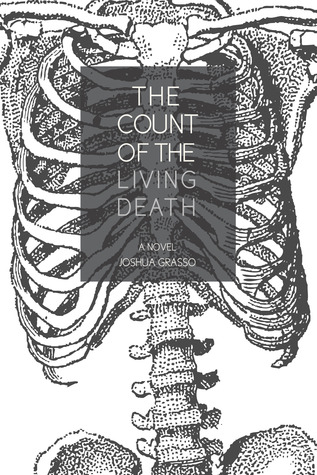
An Interview of Joshua Grasso, Author of the Comedic Fantasy - THE COUNT OF THE LIVING DEATH

12/13/2013

0 Comments

 
Picture
Picture
From time to time, I conduct an interview of another author. I find it most intriguing to get into the thoughts of another and it is great fun to get some insight into what motives another writer. Today, I have Joshua Grasso on the “hot seat.” 

Joshua, teaches English Literature, mostly British Literature from Shakespeare to the 19th century. A reader, a writer and an instructor, Joshua recently published a fantasy-comedy, The Count of the Living Death.  See my review on Grasso’s work here. 

Welcome, Joshua! I thought we would open with a quick question about The Count of the Living Death. Please share with readers what character most surprised you in this work and why?

At the outset, I thank you for this opportunity.

To your question, the character that most surprised me is Ivan, the half-brother of the main character, Count Leopold. I had originally imagined him as a kind of stock villain who would complicate things and then disappear without being a major element of the plot. But as I wrote, I realized how boring that was and how his hatred of the sorcerer, Hildigrim Blackbeard, had to be based on more than a mere dislike of sorcerers. . . so I created a back-story that connected him to the main plot in an important way and made him a much more interesting character to boot. In general, my first ideas don’t hold water. Writing often fleshes out what would otherwise be a very conventional idea. Ivan’s character ultimately changed the ending of the book as well, which was rather pedestrian in my original conception. 

I understand. Sometimes the most fun I have had when writing has come quite by surprise. Those “viola!” moments have come upon me at the most unusual times. I have had my family in an uproar more than once, with a sudden shout of “Oh, I get it now!” or something to that effect. But, the greatest moments for me were those times when I was just writing away, my fingers clicking across the keyboard and then—I would stop. Did I just write what I think I just wrote? Are those words really there?  Is it true—is that person really—? How did I not see that coming! I love those times. So, I am curious, other than the changes to Ivan’s character, was there anything else in your work that flowed from the tips of your fingers without your having been aware that it was coming? If so, how did you react? Did it change the story you thought you were going to tell?

I usually start with only a very rough outline of the work: only the ‘inciting incident’ (to borrow a scriptwriting term), something of the middle, and a general sense of how it will all end. With this novel, I actually just started writing the first chapter without any of this. I didn’t have any story ideas but had just finished a semester of teaching and desperately wanted to write something creative. The first chapter came out like a shot—a character in a coach being summoned somewhere in great haste, a sense of mystery, and something that had to be confronted. I re-wrote this chapter entirely once I figured it out, but the general tone remained, and it pretty much wrote the rest of the story for me. I always remember a letter from Tolstoy where he praised the beginning of an unfinished short story by Pushkin: “The guests arrived at the estate.” He loved that the story just opened with something seemingly important happening, so the reader wanted to know: who are they? Where are they?  And why have they arrived? In the same way, I wanted to write a story that opened “in the middle” and asked me to provide the answer. The entire story became the answer to that mysterious opening chapter—who is he, where is he going, and who summoned him? 

I will have to keep Tolstoy’s comment in mind when writing new beginnings. Speaking of new beginnings, the worlds created in fantasy works are the main reason I read in this genre. I am fascinated by the sense of adventure and the imaginations of fantasy authors. Occasionally a world is created that I might even like to visit. So, I am curious—what “other world” (which could be a time, place or fantasy place) created in any book you’ve written or read is the world you would most like to visit and why?

That’s easy, though the answer is perhaps disappointing coming from a fantasy author: Jane Austen’s England. I would love to visit and interact in the quiet, country world of Elinor and Marianne (from Sense and Sensibility), or hobnob with the social intrigues at Bath (as seen in Persuasion). Jane Austen is a tremendous influence on my work, and her world of almost claustrophobic company—just a few people in a house, a village, etc.—is the inspiration for many of my stories, which mimic the same locales and situations. No matter how fantastic, the characters are only a small band adventuring in a relatively confined space. No epic battles or time-traveling for me, as much as I love those qualities as a reader. 

Jane Austen forever! So, with your literary credentials, I can’t help but wonder what work, created by someone else, do you most wish you had written yourself and why?

The novel I most wish I had written is Neil Gaiman’s Coraline. I feel I could have written that book (not as well, mind you, but the ideas and characters are so close to what I care about). It’s a perfect book, both the actual book he wrote and the graphic novel he collaborated on. Again, we have a small, confined world, one heroine, and a completely realistic, yet imaginary world. I also love how much he does within only a hundred or so pages; Gaiman is a master of concise, powerful writing and I always come away from his books with a mixture of awe, inspiration, and envy. I could do that—but I never will! My novel, The Count of the Living Death is an attempt to capture something of the feel and sensibility of Coraline, as is my first book (which is as yet unpublished).  

I admit I have not read Coraline. It sounds like I will have to add it to my ever-growing TBR list. . . .  My next question is, I think, a difficult one and it may be even more so to someone who teaches literature. But, here goes! What would you consider the five best works you have ever read and why do you rank them among the best?

Five favorite works (which could change at any given moment) would probably be Swift’s Gulliver’s Travels, Austen’s Sense and Sensibility, the “anonymously written” Sir Gawain and the Green Knight, Spiegelman’s Maus, and Shakespeare’s Sonnets. I choose these works from the thousands upon thousands of works I love because they represent some of the reasons I got into teaching as well as writing fiction. 

Swift’s work blends science fiction and satire in a model that has been emulated by many—indeed, Planet of the Apes is virtually taken from Part 4 of the work, where Gulliver visits the land of the Houyhnhnms (the talking horses). The story is so wonderful and fantastic, yet it constantly slips away to expose the cutting—and at times, quite nasty—satire of his society. This novel is at the back of any work I write, and I’ve taught it many times over the years. 

I talked about Austen earlier, but Sense and Sensibility is a novel of satire and romance, yet neither one is pushed in your face. The satire is powerful but subtle, and the romance is always behind the scenes—even the proposals all occur off-stage. The novel is a model of restraint, and yet no book leaves me with stronger feelings—I find it a deeply moving and inspiring work. 

Sir Gawain and the Green Knight is my favorite work of fantasy, and only narrowly beats my second favorite work, Tolkein’s The Hobbit. Both works take a simple story—essentially, a quest narrative—and create a grand allegory of life, death, and individual purpose. Does Gawain fail? Is the Green Knight real? Is Morgan le Fay behind it all—or is that simply a clever way to mask the work’s real purpose? We never truly know, and you can read this short work dozens of times and find different answers. 

Spiegelman’s Maus is one of the great graphic novels that uses metaphors to uncover the truth of history and the Holocaust (the Jews are mice, the Nazis cats, etc). Yet it’s a profoundly realistic and moving story, and one that questions how well we know anyone’s story—including our own. 

The Sonnets are the most profound poetry I’ve ever read—an entire ‘play’ composed of a man’s admiration and love for a young man (whether platonic or not), that goes through a tempestuous relationship of love, doubt, betrayal, and loss. Finally, when the “dark lady” comes in at the end, the sequence becomes passionate and bitter by degrees, inspiring poetry that rivals anything in the plays, and has become part of our cultural mythology on love (both ideal and sexual). 

I understand the difficulty in choose five favorites and how likely the list is to change over time. Occasionally, however, a work has no chance of making our favorites list because it does not speak to us. What do you do when you pick up a work that does not entertain you? Do you read to the bitter end? Or do you bow out early?

No, I never finish a work if I don’t like it or don’t feel compelled to finish. However, I spend some time asking myself why I don’t like it. Did I expect something else? Am I reading another work on top of the one I’m reading? Am I shying away from the ideas/truths in the book? Is the style something I need to grapple with? Is the plot supposed to be this unpalatable or non-existent? However, if I decide a book isn’t worth my time I abandon it and quickly move on—as an academic, I have so much to read, so much to grade, and so little time of my own. Once in a while, I even abandon my own writings for committing the capital sin of writing—inducing boredom! 

I have traditionally been a “read to the bitter” end person, but with so many things to read, I’ve been re-thinking that of late! I’d like to turn your attention to literary heroes and villains. Who is your favorite heroic character—and in what way are you like him or her?

It’s hard to answer who my favorite heroic character is, since I don’t often admire ‘heroes’ per se. Many heroes in fiction and film are a little one-dimensional and hard to truly identify with. However, if we define heroes more as protagonists, who may or may not be heroic (or capable of a more simple heroism), my favorite heroine would be Anne Elliot from Austen’s Persuasion. She is a woman who has been neglected by her own family, convinced to foolishly turn down the proposal from the man she loved, and is now sailing through her twenties without any prospects except eternal loneliness. And yet she cultivates her mind, a few friendships, and wins in the end simply for being an aware, intelligent person. She’s Austen’s best heroine, or at least the most mature, and a model for anyone writing a strong female lead—one who is heroic simply by facing the music of life, even if doesn’t have a sword in hand. I’m not sure I’m anything like her, though I try to remember that life isn’t about rewards—it’s about what you do for the things and people you believe in. There is no greater reward than that. 

Well put. So, who is your favorite villain—and here’s the twist—in what way are you like him or her?

My favorite villain by far is Iago from Shakespeare’s Othello. I adore his sinister, hypocritical nature; the way he can change masks on a dime, lie to everyone by subtly twisting (or misrepresenting) the truth, and be completely unrepentant in the end. He did what he did and he will say no more, no matter how they torture him. I’m not very good at writing villains, since I tend to believe that every villain is shaped by circumstances beyond him or her, and the same might be true of Iago; but I admire the skill with which Shakespeare portrayed his vengeful nature. Anything good said about anyone else takes away from his own self-image. While I don’t think I share this quality (!), I do admire his ability to act in whatever role the situation requires, which I think is the essence of a good actor or writer. You have to be anyone, imagine anything, and have your audience follow along. That’s what I try to do both as a teacher and a writer—figure out how to reach my audience by any means necessary, or do what the work, lesson, or story requires. 

I so appreciate your taking time with me Joshua. I would like to close with a few final thoughts. In order to be certain that you’ve had an opportunity to speak to things that interest you (as opposed perhaps, to those things that interest ME), I must ask: what one question have you always wished an interviewer would ask you that you have not been asked and what is your answer to that question? Also, what one question do you most dread an interviewer asking you—and what is your answer to that question?

I would like an interviewer to ask me what I love more, writing or teaching? It’s also the question I most dread, since I don’t have a proper answer. I came to teaching much later in life, not entering a classroom until 2000, when I was in my mid 20’s and had already been writing for well over a decade. I saw myself primarily as a writer, and I figured grad school would help me along that path. But I fell in love with teaching and scholarship, and gradually, fiction became a distant second pursuit in my life. Only once I got my PhD and landed my first job did I resurrect my interest in writing fiction. Now, of course, writing takes many forms; I write articles on literature, which I publish regularly, I write paper assignments for my classes (as well as Bibles of graded comments!), informal reviews and posts on my blog, as well as novels and short stories. I could never live without writing, and yet, teaching has become my true passion, and I suspect, my actual talent. I have more experience writing, but I was more of a natural at teaching, and at the end of the day, it’s what I get paid to do. So if I had to choose, I would choose teaching (as I have), but I would also try to squirrel away a little writing on the side. 

Finally, Joshua, I would offer a simple philosophy of mine: “words matter.” The tales we tell may entertain, influence, encourage deep emotions from, and even extend profound wisdom to, others. What one lesson, theme or principle would you most want others to take from your work?

The one lesson or principle I would like others to take away from my work is simply “observation.” We don’t know anything we think we know, at least not without a ton of observation, reflection, and speculation. My characters always think they understand the big picture only to find out how few pieces they actually possess. Nothing is as it seems, and the point of a story is to examine the pieces, walk the road, and determine where we truly are in the world. I think fantasy and science fiction are uniquely qualified to ask this question, since neither of them truly exist. They’re metaphors, creating a fantastic land or planet as an elaborate way of asking “what if?” The idea of reality is thrown out the window from the beginning, so we can read the characters both as people and types, images and ideas; rings are not just rings, any more than dragons are dragons. No matter how literal you want to make it, they represent something deeper—something mythic that we continue to use as metaphors because they speak of things we don’t truly understand. Metaphors come in handy when discussing the abstract since they help us visualize it. What is time, love, honor, life, death? A story can make this seem real, or at least tangible, long enough to ask this question. A fantasy story, and the ones I write, at any rate, are a way to construct a simple metaphor to ask larger questions that we all ask, but often forget to decipher the meanings of. Of course, the question shouldn’t slap you in the face; the point of a story is to be a story, tell a story, engage our imagination. Beneath it all, however, is the question, driven by the metaphors of a world that never existed and that we make exist solely to understand ourselves.  

Thank you so much, Joshua, for joining me today!


Find out more about Joshua Grasso, fan and follow him on GoodReads here, follow him on BookLikes here and check out his website here. Joshua can also be found and you can “like” him on Facebook here. The Count of the Living Death is available from Amazon here. 


Don't miss the sale on Amazon starting December 16--just in time for the holidays!  Pick up a copy for yourself or for someone on your gift list.

0 Comments

Favorite Traditional and Indie Published Fantasy Works

12/6/2013

1 Comment

 
Picture
First up this month, is C.M.J. WALLACE
http://cmjwallace.com
Picture
For this month’s topic, we decided to identify one traditionally published and one indie-published fantasy novel that we enjoyed and explain why. My fellow Quillers won’t know this until they receive my portion of our post, but I have a great deal of difficulty reading indie work because of the poor editorial quality and have finished only a few of the many I’ve tried. I’m not saying that traditionally published books are all well edited; far from it. But as a rule, they’re in much, much better shape than indie books. (By the way, we recused ourselves from reading one another’s books and I haven’t read any of their work; my comments don’t apply to their writing!) I edit for a living, which means I look for errors in grammar, structure, punctuation, continuity—the whole shebang. But I don’t actually look for them: They leap out at me, and that makes it impossible to ignore them as I read for pleasure. Therefore, I haven’t found an indie fantasy story I like.

My favorite traditionally published fantasy author is Stephen R. Donaldson. His Mordant’s Need series, which includes The Mirror of Her Dreams and A Man Rides Through, is one of the most satisfying fantasies I’ve ever read. (And yes, it’s well edited!) The language is beautiful and evocative, which is difficult to find these days. In fact, some of the most popular books of the past decade are devoid of rich prose and barely rise above the fourth-grade reading level typically used in newspapers. I truly don’t understand the attraction.

But I digress.

Donaldson’s tale rests on a solid foundation of back story that adds intricate layers of realism, which I believe is a must for any narrative that strives for depth. The heroine, Teresa, is wimpy and at times spineless—the Donaldson books I’ve read lack strong female characters in general—but I otherwise like the series so much that it doesn’t detract terribly. Although she is one of the main characters, she shares the stage with a man who does make a fulfilling hero despite his flaws and helps compensate for her shortcomings.

I prefer complicated plots, and the author delivers. The kingdom is at war, mysterious saboteurs are trying to bring it to its knees from within for reasons unknown, the protagonists and the mad king may be more than they seem, and the heroine has entered Mordant through a mirror in our world (very Lewis Carroll, and a device I’ve been in love with since I first read his books).

But the primary reason I love Mordant’s Need is that the series brings alive another world, as any good book should, taking me out of time and place and firing my imagination. And I can visit as often as I like.

ROBIN LYTHGOE is next!  
http://www.robinlythgoe.com
Picture
Oh, decisions, decisions…! Choosing just two fantasy novels is nearly like asking me to pick my two favorite children. Still, there are a certain number that qualify. One would think that with all the thousands of books available, I might have a lot more favorites, but all too often I find myself throwing my hands up in disgust at issues that plague traditional and indie books alike: weak plots, poor editing, cardboard characters, and a lack of voice. In fact, the last hair-tearing book I read was traditionally published, and I kept wondering what the company did with their editors. On the indie front, I’m starting to see a noticeable division between those publishing because they can and those who are serious about this writing business. I will confess, if the cover is horrible, the chances of me reading it are extremely slim. The cover represents what’s inside. Yes, I must first be intrigued with pictures.

So you can imagine my squeak of delight when I saw the cover of Brood of Bones, by indie author A.E. Marling. The artworks is by Eva Soulu, and I’d like to have that print hanging in my house, it’s so lovely. The book didn’t disappoint, either. A magic-wielder afflicted with a sleeping disorder is caught up in a fantastic terrific whodunnit. The setting and the magic are skillfully portrayed; the characters are complex and not always predictable. The main character, Hiresha, struggles not only with her sleeping problem, but with the past that has formed her; her position is her armor and her purpose. Maid Janny is a gem of irreverence, while the Lord of the Feasts is both charming and terrible. The deposed arbiter of the city is exasperating at the same time she is delightful, and the two city leaders (a pair of priests representing different deities) are not what they might seem. The formatting and editing are first-rate—and I’m picky, so you can relax on that count.

Traditional-wise, I think Michael Whelan became one of my favorite fantasy artists when I came across The Dragonbone Chair, first in the Memory, Sorrow, and Thorn series by Tad Williams. Three wonderfully thick books long (the paperback publication of the third was divided into two volumes), the series has yet to be knocked off its pedestal as my all-time favorite epic fantasy. The world Williams describes is intricate and deep, with a rich (but not overwhelming) history. The characters—well, it’s easy to forget they’re the product of someone’s imagination. There are complex cultures and races, folklore, humor, tragedy and growth all masterfully blended into the grand conflict of Good against Evil. The power struggle between the heirs to the throne and the presence of three magic swords might sound like standard fare, but it’s just so darned well done! Toss in alliances, betrayals, politics, epic military battles; then factor in world building and character development, pacing, and emotional impact, and by golly, if you haven’t read this, what are you waiting for??

Here are my thoughts--
Picture
There is no shortage of traditional published fantasy works from which to choose a favorite. Even so, a single one comes to mind. It is a work I’ve read—I think five times now—and it is the one that encouraged me to write myself (not because I could hope to match it, but because it made me hungry to experience the process). That work is Terry Goodkind’s Sword of the Truth Series, which begins with Wizard’s First Rule.

I am fascinated with Goodkind’s ability to keep me on the edge of my seat, constantly turning pages, waiting with baited breath for the next thing to happen—because there is not a moment in which something is not happening. With heart hounds, dragons, wizards, sorceresses, the Seeker of Truth, the Mother Confessor, horrific villains, and so many more creatures and characters, some wholly new and unique, Goodkind’s story is utterly spellbinding. From this series (which I estimate runs 8 - 10,000 pages), I can readily name more than 50 “main characters.” These are characters central to some portion of the story, characters I got to know throughout the series, characters I may love or hate—but will never forget. Add to this Goodkind’s ability to weave elements of the story—sometimes beginning with a mere mention early on and then reintroducing that element volumes later when it becomes a key ingredient to the overall story—and you have a truly great series. For this reader, Goodkind is unmatched. 

As to indie published fantasy works, I admit that I have not read all that many, but one I found particularly well done and entertaining was The God King (Heirs of the Fallen Book 1), by James A. West. Notwithstanding the fact that this work makes use of names with (what to me are dreaded) apostrophes (“Geh’shinnom’atar), and notwithstanding the fact that the work includes “dead people walking,” (two things I generally highly dislike reading or reading about), I found The God King quite enjoyable. 

West’s voice is intriguing, his word pictures are carefully painted, and his word choices clever in that they help to create a unique alternate world. West’s characters were honorable at times, quirky at times, but always consistent and in the end, believable. Perhaps the highest praise I could offer in this regard is that West drew, in The God King, a genuinely legitimate lead woman character.  She was firm in the face of danger, was committed to helping to overcome evil, and was a full member of the otherwise all-male “team.”  


Finally, let's here what Kristie Kiessling has to say--

KRISTIE KIESSLING
www.KristieKiessling.blogspot.com
Picture
When browsing through the "cheap seats" (read: FREE) of indie books, I came across the short A Circle of Iron by Greg Benage. Taught from childhood that "we don't judge books by their covers", I nevertheless found myself intrigued. I'll be honest, if the cover turns me off, I move on. Perhaps it was the simplicity, the colors, I can't really even say. Maybe it was the title that bears a striking similarity to a 1978 martial arts movie. But, it was free, (and still is) so I snatched it up. I expected poor writing, poor characters, poor ... well, everything. I wasn't disappointed. Let's face it; indie publishing is writers putting their work out there (often) without benefit of the many years of savvy that traditional publishing provides. We're doing this on our own, working our way through the ropes and hoping we find mentors along the way. It is a gritty, sometimes dark business. A Circle of Iron is gritty and dark with bounty hunters chasing down and slaughtering blood drinking wights. It is a fantasy full of violence set in the world of Eldernost.

Here's the weird thing: I liked the characters despite their too-convenient back stories. I liked the bad guys. Though they were predictable too, I thought they could be so much more. There were hints of much more, and the too short tale never delivered more than hints. The story had potential but it bogged down, despite being so short, when the author used unnecessary foul language. Worse, he used colloquialisms that drew me out of the nebulous at best setting and into the present day. I half expected someone to hand the hero a cola at some point. 

I do hope Mr. Benage keeps trying. I think he could actually write something exciting if he really put his mind to it. This felt a bit to me as though he had this tale and tidied it up and published it to get out there. I don't blame him for that, I just hoped against hope for more. If I'd been allowed to tell you about As the Crow Flies by Robin Lythgoe, I would have chosen that as my enjoyed indie read.

That story carries well what is the burden of indie works: to make them better than the world expects them to be because they are indie works.

My traditional selection of a story I enjoyed is Hood by Stephen R. Lawhead. Lawhead has long been one of my favorite authors and his novels lean toward the historical, but there is that element of magic that speaks to fantasy and I love that. Hood is the tale of Bran ap Brychan, heir to the throne of Elfael. Set in the primeval forest that borders Wales, it is a retelling of a familiar old legend full of Celtic mythology and political intrigue. At just shy of 500 pages it is an epic worthy of the name in all aspects. Hood swept me away into the greenwood and carried me along with Bran through battles, Normans, the Red King and the discovery of a destiny of which no runaway, reluctant hero could have dreamed.

I am excited by what independent publishing can offer the world and I believe that the future of indie is rich worlds and tales along the lines of As the Crow Flies rather than A Circle of Iron. As for Lawhead and Hood they have given me what traditional publishing has almost always delivered, that excitement of worlds unknown kindled in me when I was young and read Tarzan or The Hobbit.


Thank you so much for joining  A DRIFT OF QUILLS this time around!  Please let us know your thoughts.
1 Comment

Adding to my Bucket List

11/23/2013

0 Comments

 
About an hour from Paris, is the Palace of Fontaintebleau. Originally at the site—dating back to the twelfth century—was a royal hunting lodge. The royal palace construction began in the sixteenth century. Inside, the palace boasts great artwork; outside, complex patterned gardens. According to UNESCO, Fontainebleau “has retained the imprint of every reign and every style:  Henri IV, Louis XIII, Louis XV and Louis XVI. . . ."  

Today, the chateau is a popular place for visitors to explore. I read that if you walk the gardens too long and become too exhausted, a horse drawn carriage may just give you a tour back to the chateau where peacocks freely roam the grounds. It sounds like quite the adventure. . . .

Picture
But what brings me to the Fontainebleau today is not the grounds. Rather, here I seek—the Library, which I have added to my “bucket list” (of libraries I would like to see one day). Photos of the library show massive globes that run down the center aisle of the room. Unfortunately, while I found a great deal of information about the Palace itself, there does not appear to be much information available about the works housed in this library—if indeed any remain today. 

I did locate one truly excellent article about Fontainebleau that covers works held in the library from days gone by. See: http://writingren.blogspot.com/2012/07/a-king-and-his-books-libraries-of.html. Beyond that, does anyone know whether this library still houses works and if so, how many and covering what general subject areas? I would be curious to know.


0 Comments

Content Rating:  What the Bleep?!

11/1/2013

0 Comments

 
Picture
Today, A Drift of Quills is focusing its attention on content ratings. Not on the ratings of our works by readers, but of our works for readers. These ratings, adopted from the motion picture industry, differ by country, but we’ll be referencing the current—as of 2013—U.S. system. (See more at Wiki’s Motion Picture Rating system here and from the Motion Picture Association of America, What Each Rating Means here).

What are our positions, or what difficulties might we have writing things rated beyond a PG-13? Do we write such things? Why or why not?


I'm up first!
Picture
PATRICIA REDING
Author of Oathtaker


My work falls into the PG-13 category in part because I want to be able to promote it to the YA crowd. As a way of putting my thoughts into focus, I will set forth my position only on the following areas: sex, drugs, and violence.

I believe that some things are private and are meant to be so. This is not necessarily because they are bad things but, rather, because they are so personal that they are, dare I say, “sacred.” Sacred is defined as “regarded with reverence.” A synonym for the word is “inviolate,” defined as: “free from violation, injury, undisturbed; not infringed.” For this writer, to open the door on things that take place in private would be a betrayal of my characters—a violation of them—an injury to them.

I respect my characters and so, allow them their privacy. I also respect my readers—and in particular YA readers. My youngest daughter brought a book to me one day (marketed as YA), outraged by the story line. It seems the protagonist was trying to determine how best—and quickest—to rid herself of her innocence. The work quickly made its way to the trash bin. I believe the author of that work held an enormous responsibility to her readers—and in my estimation, she failed in it. Whereas she could have helped to insure her readers’ physical and mental health for the long haul, she instead titillated her readers, encouraged them even, suggesting that there were no limitations and no consequences. So, while I fully defend one’s choice to write outside the PG-13 category, I do not do so because I believe such works should not be promoted to the highly impressionable YA crowd.

As to drugs/alcohol, my position is that a work designated as YA appropriate should never promote the use of drugs or the irresponsible use of alcohol nor should they include YA characters thoughtlessly imbibing. If for no other reason than to help to insure the safety of young women (in particular) who all too often are victimized--especially when their defenses are down as a result of the use of drugs/alcohol—such conduct should not be encouraged. Our readers are taking cues from us. . . .

The real world includes open violence and it often is violence that differentiates the good from the evil. Moreover, with evil, violence and sex may meet. My works do include references to such behavior; evil frequently manifests itself in this way. However, I have found that few details are necessary. I need not insult my reader by elaborating on the obvious. These things can be exceedingly offensive and painful. I find no entertainment value in them. Moreover, when one writes, a phenomenon occurs. In order to relate a tale to her readers, an author must look at the details. I have found that I reach a point where I must close my eyes, where I cannot allow myself to see or to hear more—even though I know it exists. Beyond that place, I will not go. Beyond that place I will allow my reader to use her own imagination—should she be so inclined.


So, next in line is:

Picture
KRISTIE KIESSLING
Author of the short story Sanguis Dei and a poetry collection Light and Dark

Kristie's blog is found here.


I am a firm believer in writing what I know. Sometimes, the things I know are not so nice. The world we live in is not always a nice place and that is why we, as adults, are the barriers between our children and the written word that may make too strong an impact at the wrong time. This is why I believe in parental interaction with teachers throughout the school years. I know my child best. Teachers and parents must partner in education. In this vein, When my children were in grade school, I read everything they were required to read so that I knew if it was appropriate for them. If I felt it was not, I would request another reading assignment. That is a parent's job.

As a writer, I don't write fiction for children or young adults. My stories are written for adults with adult consequences for adult actions. Even so, I consider the PG-13 guidelines (which you may read by clicking on the link at the end of my entry) to be a very good line in the sand. They are a point at which I pause and say to myself, "Do I need harsh language? Do I need this scene, this level of graphic depiction?" Usually, the answer is, "No." Inclusive of everyday life, I'd very much like it if, when in the public eye, people confined themselves to actions and speech we'd consider G. But the world isn't G rated or even PG. It is a scary place. For my writing to attract the audience I want, fiction I can share with everyone, fiction of which I can be proud, I recognize that there may be times when gentle words aren't enough.

There are times when even the guidelines for PG-13 go beyond what I would write and times, I confess, where they may not go far enough. In my writing, I lean toward strong violence: war, death, illness, occasional drug use. I probably skirt that line between PG-13 and R. I don't dive fully into the R rating. I don't need it. I also don't want to be told I can't write it if I think it will add to the tale I'm telling. At this time of my life, with adult children, I do ask myself, "Would I let my daughter read this? My pastor?" I'm happy to say that the answer is, "Yes." It's "yes" because I believe in the intelligence and understanding of my target audience. Would I want my grandchildren to read it, if I had any? No. Not because I am ashamed, but because it isn't written for them. Should I then not put my stories out there because of who might read them? Again, no. Every person must take responsibility for what they produce and must educate themselves about what they may face within the context of certain genres.


Our next member has her own take:

Picture
C.M.J. WALLACE
Author of The Rift Series (beginning with Sing the Midnight Stars)


C.M.J.'s website is found here.


Although I include sex in my books, it’s only implied unless it’s not consensual and that choice isn’t something I had to ponder: I’ve simply never considered writing any other way. However, when I do use the device I’m not shy about it. For example, I wrote a situation in which a husband and wife are raped in turn, and it’s brutal and graphic, yet I cringe at the thought of writing a steamy love scene. Strange but true. I think part of the difference is that, to me, something such as rape is not so much sexual as it is pure violence, and that’s easy for me to write (don’t make any horrible inferences here!).

I’m not a fan of the romance genre, which hinges on hanky-panky these days, it seems, so I’ve never found that explicit sex scenes are essential to any story I’ve read (and I’m not at all convinced that they’re essential even in romances). They tend to make me roll my eyes and skim until I hit the next nonlascivious part that’s actually related to the plot. And that’s another reason I don’t use that contrivance: what does sex in most books really have to do with the story line? In almost every instance I’ve seen, it’s gratuitous and detracts from the narrative. In fact, I recently stopped reading a book after being subjected to yet another of the author’s superfluous descriptions, and this one crossed the line into the profanely indecent.

Some may believe that graphic (or not-so-graphic) sex in their writing will help sell books, but one word refutes that opinion: Rowling. One could argue that it’s the lack of such content in the latter books of her Harry Potter series that helped it retain its enormous popularity.


Our last member and "partner in crime" has this to say:

Picture
ROBIN LYTHGOE
Author of As the Crow Flies and two short stories


Robin's website is found here.


I am going to say right out that I am not a fan of a rating beyond PG-13 in either books or movies. A great number of recent offerings are being touted as “gritty” and “dark,” when what they really seem to mean is “violent, vulgar, and explicit.” I firmly believe that stories can be gripping, thrilling, thoughtful, controversial, breathtaking or entertaining without resorting to extremes. It’s a shame, really. I understand the desire to write for a so-called “adult” audience, but why does an adult audience need lower standards than a less-adult one? (And are we talking age or maturity here?)

It is interesting—and somewhat telling—how the lower ratings are falling out of favor. There is an unvoiced opinion that somehow they mean the tales are for children. Material is often added in, appropriate or not, to give edgier ratings. As a society we are actively, purposefully working to desensitize ourselves.

“What? But I can’t accurately depict my characters if they don’t swear a blue streak, graphically hurt their enemies, or have detailed sexual relationships!”

Seriously? What that really means is that the author isn’t creative or resourceful enough to figure out an alternate way of delivering the scene. Yes, bad language, violence, drugs, and superficial whoopee happen every day in “real life,” and some of those situations are part of truly intense stories. But they do not have to be spelled out in gory detail and they do not have to be advocated. The lack of harsh characteristics does not equate poor reading material. We do our readers a grave injustice when we don’t trust that their imaginations will carry them through, that they will pick up on individually pertinent details and fill in the blanks to create a scenario that is meaningful to them.

Moreover, why would an author or producer want to deliberately limit her audience? I do not write specifically for the Young Adult market, but I am thrilled when someone from that audience not only can read my book, but enjoys it (and hello! BUYS it!). And is there an ample market for PG-13 and gentler books? Why, yes, there is. I am encouraged by the response to author Leeland Artra’s fledgling Facebook group, (found here) “Fantasy Sci-Fi Network News,” which is “a collection of authors, bloggers, and reviewers who are passionate about finding and creating quality fantasy/sci-fi books which are also teen safe (G, PG, or PG-13 rated). The FSF Network believes it is possible to create fantastic works of fantasy and science fiction without resorting to graphic violence, explicitly harsh language, or sex.” Two weeks, 200 followers. From my point of view, that’s a good sign.


Thank you for stopping by to join A Drift of Quills!     

0 Comments
<<Previous
Forward>>

    Patricia Reding

    Here is where Patricia has posted interviews of other authors as well as her own thoughts on a wide variety of subjects. As to the interviews, the questions posed are intended to pull from authors, some interesting information about them that might otherwise have gone unknown. . . .

    Archives

    July 2016
    December 2015
    September 2015
    June 2015
    April 2015
    March 2015
    February 2015
    January 2015
    December 2014
    November 2014
    October 2014
    September 2014
    August 2014
    July 2014
    June 2014
    May 2014
    April 2014
    March 2014
    January 2014
    December 2013
    November 2013
    October 2013
    September 2013
    August 2013
    July 2013
    June 2013
    May 2013

    Categories

    All


Powered by Create your own unique website with customizable templates.